Introduction: The Small Component That Makes a Big Difference
Every time you hitch or unhitch your trailer, you rely on one critical component: the trailer jack. It might not get the spotlight like hitches or brakes, but without a solid trailer jack, loading, parking, and towing can turn into a frustrating and potentially unsafe experience. A jack is a vertical device positioned on the tongue of the trailer that helps lift or lower your trailer to make it perfectly level.
Choosing the wrong jack can lead to bent frames, unstable hitching, premature wear, or even dangerous detachment. But with so many options on the market—side wind, top wind, drop leg, swivel, manual, electric—how do you know which one is right for your trailer?
In this comprehensive guide, we’ll walk you through everything you need to know to choose the perfect trailer jack for your specific application.
Step 1: Calculate Your Trailer‘s Tongue Weight
The single most important factor in choosing a trailer jack is tongue weight—the downward force the trailer places on the hitch ball. If your jack isn‘t rated for your trailer’s tongue weight, it will wear out fast and can fail unexpectedly.
How to Calculate Tongue Weight
As a general rule, tongue weight should be 10 to 15 percent of your trailer‘s total loaded weight. For example, a 5,000 lb trailer needs about 500 to 750 lbs of tongue weight.
Here’s how to determine your tongue weight:
-
Check your owner‘s manual – The manufacturer’s recommended tongue weight is usually listed
-
Use a tongue weight scale – A dedicated gauge gives you an accurate reading
-
Visit a public scale – Weigh the trailer fully loaded, then weigh it with only the rear axle on the scale
-
Consider all cargo – Don‘t forget batteries, propane tanks, and heavy items stored toward the front of the trailer
The Golden Rule: Always Overrate Your Jack
Always choose a jack rated higher than your trailer’s tongue weight. A good rule of thumb is to select a jack with at least 20% higher capacity than your calculated tongue weight. Underrated jacks wear out prematurely and can fail when you least expect them.
Step 2: Understand the Different Types of Trailer Jacks
By Operation Type
Manual Trailer Jacks
Manual jacks use a hand crank to lift and lower the tongue. They require physical effort but have fewer maintenance concerns and are more budget-friendly. Manual jacks tend to be lighter, take up less space, and are less likely to need maintenance because there‘s no wiring or motor to fail.
Best for: Budget-conscious buyers, light-duty applications, and those who don’t mind a little physical exertion.
Electric Trailer Jacks
Electric jacks use a powered motor to raise and lower the trailer at the push of a button. They‘re ideal for heavier loads and frequent use. Most electric jacks include a manual override crank in case of power loss.
Best for: Heavy trailers, frequent use, and anyone who wants convenience and speed.
By Mounting Style
A-Frame Jacks
These mount directly to A-frame style tongues—common on utility, car hauler, and enclosed trailers. They’re sturdy, simple, and widely used. A-frame jacks are more central to the trailer centerline, which provides a very good loading condition.
Best for: Travel trailers, enclosed cargo trailers, and larger boat trailers.
Straight Tongue Jacks
These mount to straight (pole) tongues and are typically side-mounted. However, side-mounted jacks create a twisting moment—the farther they are from the trailer centerline, the greater the twisting force.
Best for: Utility trailers and applications with a straight tongue design.
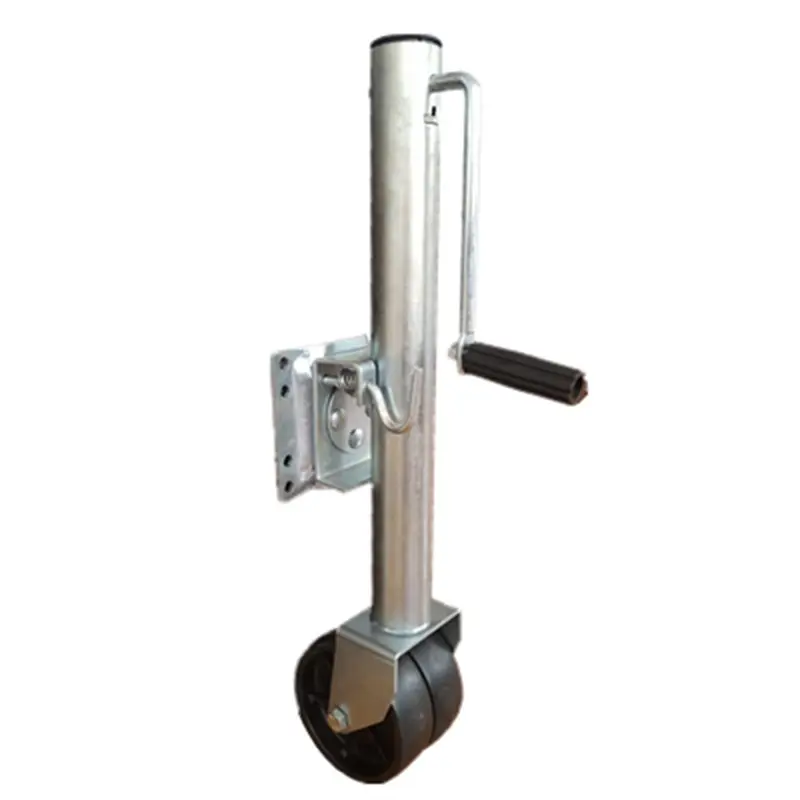
Swivel Jacks
Swivel jacks rotate up and out of the way once the trailer is hitched. This adds ground clearance and makes towing easier, especially on uneven terrain or driveways. The increased ground clearance is the main benefit—it‘s less likely to hit the ground accidentally when pulling over bumps, curbs, and ramps.
Best for: Trailers where ground clearance is a concern.
Drop Leg Jacks
Instead of cranking endlessly, drop-leg jacks let you pull a pin and extend the leg quickly. This drop movement decreases the amount of cranking required to raise the trailer tongue. Some drop leg jacks include a spring-loaded foot that retracts on its own after the pin is withdrawn.
Best for: Heavier trailers where efficiency matters.
By Handle Orientation
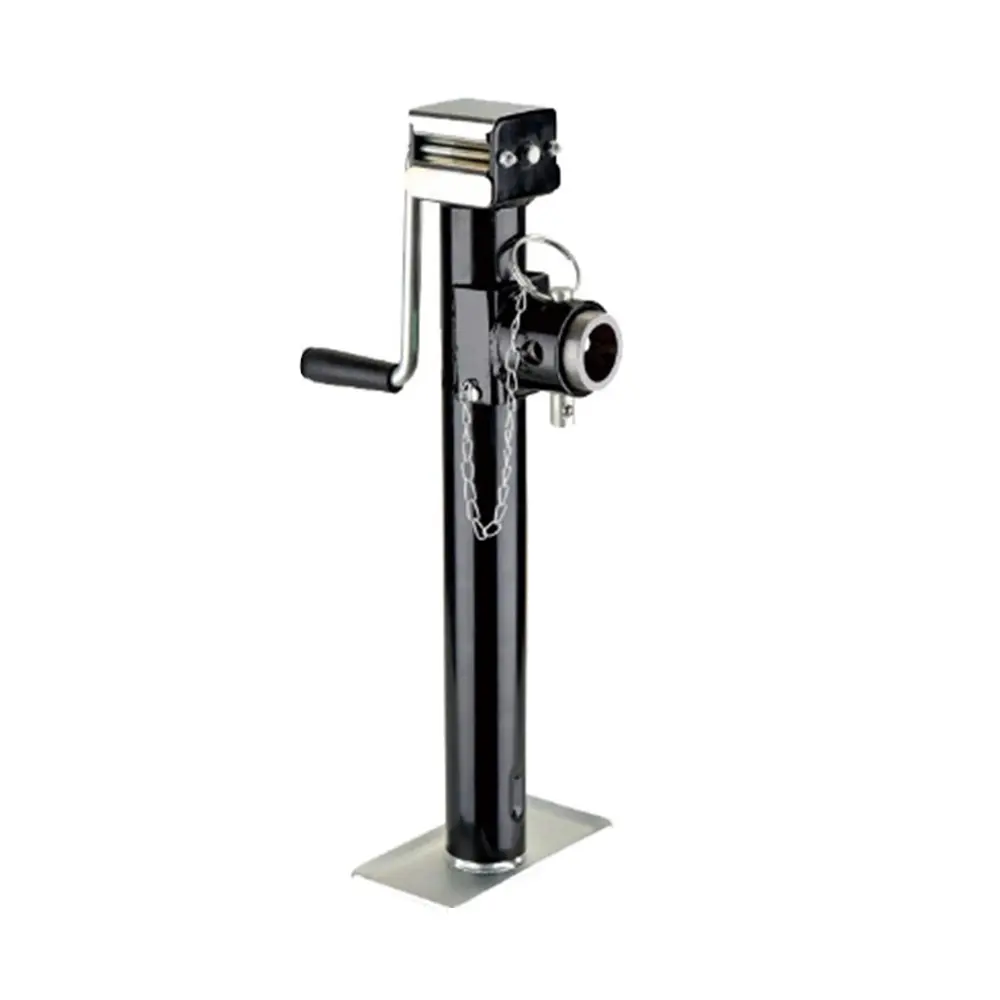
Side Wind Jacks
The crank handle is positioned horizontally on the jack‘s side. Side wind jacks are ideal for tight spaces where vertical clearance is limited. However, the gears are exposed to debris and corrosion, requiring quarterly lubrication. Typically rated for up to 5,000 lbs.
Top Wind Jacks
The crank handle is positioned vertically atop the jack. Top wind jacks feature a sealed gearbox that protects internals from moisture and debris. They support higher load capacities—up to 15,000 lbs or more—but require vertical clearance and more complex maintenance.
Step 3: Consider Ground Clearance and Lift Range
Ground Clearance
A low-hanging jack can scrape or bend during turns or on uneven surfaces. Swivel or higher-mounted options help prevent damage. Measure your trailer‘s ground clearance when fully loaded and choose a jack that won’t drag.
Lift Range (Travel Size)
Travel size (vertical lift range) determines how high a jack can raise a trailer coupler. Insufficient travel risks incomplete hitching or instability on uneven ground.
Minimum Travel Required = (Trailer Coupler Height – Truck Hitch Height) + Safety Margin (4″)
Common Travel Sizes:
-
6″–10″ Travel: Light-duty trailers (utility trailers, horse floats)
-
12″–18″ Travel: Heavy-duty trailers (construction equipment, lowboys)
-
20″+ Travel: Specialized applications (off-road trailers with oversized tires)
Pro Tip: For uneven terrain, add 50% extra travel to accommodate ground variances.
Step 4: Choose the Right Material and Finish
The material and coating of your trailer jack determine its lifespan, especially if you operate in harsh environments.
| Material | Best For | Expected Lifespan |
|---|---|---|
| Zinc-Plated Steel | Inland use, budget-conscious buyers | 3–5 years |
| Hot-Dip Galvanized | Road salt and marine environments | 8–12 years |
| Stainless Steel | Marine trailers, maximum corrosion resistance | 10+ years |
Maintenance Note: Side wind jacks require quarterly lubrication due to exposed gears, while top wind jacks need annual gearbox inspections.
Step 5: Decide Between Weld-On and Bolt-On Installation
Bolt-On Installation
Bolt-on jacks are a good choice if you want or need to replace the jack in the future. They offer flexibility and are easier to install with basic tools. Bolt-on jacks can handle significant weight as long as the mounting hardware is properly maintained.
Best for: Applications where future replacement or adjustment is likely.
Weld-On Installation
Weld-on jacks are much more secure and permanent. You don‘t have to worry about keeping tabs on the mounting hardware to make sure it’s still secured. Weld-on installations are typically preferred for permanent setups, fabricated trailer builds, and maximum rigidity.
Best for: Permanent installations and heavy-duty applications.
Step 6: Factor in Safety and Compliance
-
DOT Compliance: Ensure jacks meet FMVSS 393.130 for load stability
-
Corrosion Resistance: Look for ASTM B117 certification
-
Static vs. Dynamic Load: Jacks are rated for static loads (stationary trailers). Reduce capacity by 50% for dynamic operations like hitching and loading
Quick Selection Checklist
Before you buy, ask yourself:
- □ What is my trailer‘s tongue weight?
- □ Have I added a 20% safety margin to my capacity requirement?
- □ What type of tongue does my trailer have (A-frame or straight)?
- □ Do I need a swivel jack for ground clearance?
- □ Would a drop leg jack save me time on a heavy trailer?
- □ Do I prefer manual or electric operation?
- □ What is my required lift range (travel size)?
- □ Will I be operating in a corrosive environment?
- □ Do I need bolt-on or weld-on installation?
Final Thoughts
The choice between different trailer jacks isn‘t about which is “best” in absolute terms—it‘s about which is right for your specific trailer and application.
Manual jacks offer durability and budget-friendliness. Electric jacks deliver convenience and speed. Side wind jacks fit tight spaces. Top wind jacks handle heavier loads. Swivel jacks provide ground clearance. Drop leg jacks save cranking time. Bolt-on offers flexibility. Weld-on delivers permanence.
Whatever you choose, remember this: always overrate your jack’s capacity, measure your clearance and lift needs carefully, and prioritize quality. A jack that fails can cost you far more in damaged equipment, lost time, and safety incidents than the price difference between entry-level and premium options.
The HangCheng Advantage
At HangCheng, we understand that choosing the right trailer jack isn‘t just about lifting a trailer—it’s about protecting your equipment, your cargo, and your team.
Our trailer jack lineup includes:
-
Side Wind and Top Wind models to match your clearance and capacity requirements
-
Drop Leg jacks for quick, efficient lifting on heavier trailers
-
Swivel jacks that rotate out of the way for maximum ground clearance
-
Manual and Electric options to suit your budget and convenience needs
What sets HangCheng apart is our full-cycle design-to-manufacturing capability. We don‘t just stock standard jacks—we engineer solutions. Need a specific mounting bracket configuration? We deliver. Require a particular load capacity or drop length? We’ve got you covered. Our integrated approach—from precision engineering to ISO-compliant production—ensures consistent quality, shorter lead times, and lower total cost of ownership.
Contact us for more information; bulk orders enjoy discounts.
Related Products