Introduction: Why Size Matters
Selecting the correct wheel chock size is not just a matter of convenience—it is a fundamental safety decision. A chock that is too small for the tire it is meant to secure can be easily rolled over, offering little to no resistance and putting nearby personnel, equipment, and the vehicle itself at significant risk. Conversely, a chock that is too large may not seat properly against the tire’s tread, rendering it equally ineffective .
This guide provides a clear, step-by-step methodology for selecting the correctly sized wheel chock for your specific vehicle, focusing on the essential relationship between tire diameter and chock dimensions.
The Golden Rule: The 1/4 Tire Diameter Rule
The most fundamental and widely cited principle for selecting the correct wheel chock size is the “1/4 tire diameter rule.” This industry-standard guideline states that a wheel chock should be roughly one quarter (1/4) of the tire’s total height . This ensures the chock is tall enough to snugly fit the tire’s curvature, allowing gravity and the vehicle’s weight to work with the chock, not against it.
How to Apply the Rule
-
Measure the Tire Diameter: Determine the overall diameter of the tire you intend to chock.
-
Calculate the Required Chock Height: Divide the diameter by four. The resulting figure is the minimum recommended height for your wheel chock.
Examples of the 1/4 Rule in Practice
| Tire Diameter | Recommended Minimum Chock Height |
|---|---|
| 26.7 inches (e.g., 245/45R18) | ~6.5 inches |
| 36 inches | ~9 inches |
For a tire with a 26.7-inch diameter, a chock height of 6.5 inches is required. Many standard chocks are approximately 6 inches tall and may still be capable of securing the trailer, but for maximum safety and a proper fit, the calculated height is the benchmark to aim for .
The GVW Dimension: Why Weight Matters for Size
Tire diameter dictates the necessary height of a chock, but the Gross Vehicle Operating Weight (GVW) plays a critical role in determining its overall strength and holding capacity. A taller chock designed for large tires may not be structurally adequate for a very heavy vehicle if it is not rated for that load .
Leading manufacturers like Checkers use a combined Tire Diameter and GVW matrix to guide selection. This table illustrates how both dimensions must be matched to ensure a safe and effective hold.
Wheel Chock Selection Matrix (GVW vs. Tire Diameter)
This table, based on Checkers’ testing methodology for 8% grade roads, highlights the critical relationship between vehicle weight and tire size .
| Tire Diameter | Up to 32″ | Up to 35″ | Up to 38″ | Up to 46″ | Up to 65″ |
|---|---|---|---|---|---|
| Up to 30,000 lbs | UC1700 / UC1400-4.5 | UC1700 | UC1500-4.5 | UC1500-4.5 | MC3009 / UC1210 |
| Up to 40,000 lbs | UC1600 / UC1400-6 | UC1600 | UC1500-6 | UC1500-6 | MC3009 / UC1210 |
| Up to 50,000 lbs | UC1400-6 | UC1500-4.5 | UC1500-6 | UC1500-6 | MC3009 / UC1210 |
| Up to 60,000 lbs | UC1500-4.5 / UC1400-6 | UC1500-4.5 | UC1500-6 / AT3512 | UC1500-6 / AT3514 | MC3009 / UC1210 |
| Up to 70,000 lbs | UC1500-6 | UC1500-6 | AT3512 | AT3512 | MC3009 / UC1210 |
| Up to 80,000 lbs | AT3512 | AT3512 | AT3512 | AT3514 | MC3009 / UC1210 |
| Up to 150,000 lbs | — | — | — | AT3514 | MC3009 / UC1210 |
| Up to 245,000 lbs | — | — | — | MC3009 | MC3009 / UC1210 |
| Up to 366,000 lbs | — | — | — | — | MC3010 |
Table source: Compiled from Checkers Wheel Chock Reference Guide . For extreme weights over 366,000 lbs, specialized configurations are required.
Understanding the Variables That Affect Chock Performance
Beyond tire diameter and GVW, several other variables can significantly impact chock effectiveness and must be considered during selection and use .
1. Tire Type: Radial vs. Bias-Ply
Radial tires deflect more than bias-ply tires. While this flexibility allows the vehicle to move more smoothly, it also allows the tire to wrap around the wheel chock, which reduces the chock’s effectiveness . In such cases, a slightly larger chock may be needed to compensate for this efficiency loss.
2. Ground Surface Conditions
The condition of the ground is a key determinant in the type of chock to use :
-
Frozen or Icy Terrains: Choose a chock with a cleated bottom for maximum grip.
-
Wet or Muddy Terrains: Multiple chocks may be necessary to ensure safe chocking.
-
Soft Ground: Chocks with a wider base prevent sinking into the surface.
3. Grade of the Terrain
The angle or grade of the terrain determines how chocks must be positioned. As a rule of thumb, add ~50% chock height for every 5° of grade . A vehicle parked on a 10° grade with a 600 mm tire needs a 200-225 mm chock, not the level-ground 150 mm.
Proper Chocking Procedures: Positioning is Everything
Selecting the correct wheel chock is only half the battle. Proper placement is equally crucial for safety. Always adhere to these fundamental rules :
-
Always Use Chocks in Pairs: One chock is insufficient to secure a vehicle.
-
Correct Positioning: Ensure the chock is centered and squared against the tire tread.
-
Position Snugly: Place the chock tightly against the tire tread.
-
Grade-Specific Placement:
-
Downhill: Place chocks in front of the front wheels.
-
Uphill: Place chocks behind the rear wheels.
-
Level: Chock both the front and back of a single wheel.
-
Common Mistakes to Avoid
-
Wrong Size or Rating: Using chocks too small for the wheel diameter or vehicle weight reduces effectiveness. Always follow manufacturer load ratings and wheel-size guidance .
-
Incorrect Placement: Placing a chock too far from the tire contact patch or on the edge of the tread reduces holding power .
-
Relying Solely on Chocks: On steep grades or during heavy loading, combine chocks with parking brakes, wheel locks, or mechanical restraints .
-
Using Damaged Chocks: Continuing to use chocks with cracks, deep gouges, or significant compression can lead to failure .
The HangCheng Advantage
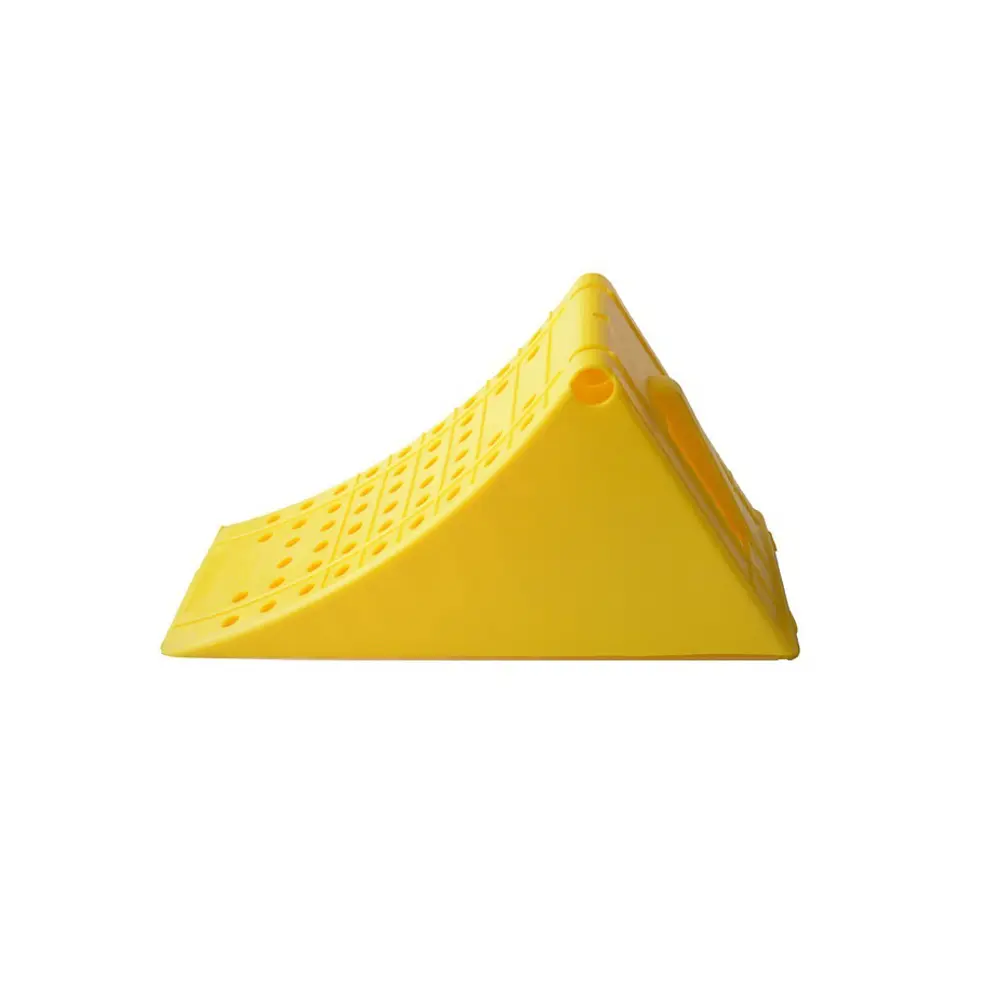
At HangCheng, we offer a comprehensive range of wheel chocks designed to fit a variety of tire sizes and weight capacities. Our product lineup includes both high-visibility yellow plastic (polyurethane) chocks and heavy-duty rubber options, ensuring you can find the perfect fit for your specific application.
-
Complete Size Range: We provide chocks in various sizes, from models ideal for 27″ to 32″ tires, up to heavy-duty options for tires up to 46″ and beyond, ensuring you can follow the 1/4 rule precisely.
-
Material & Durability: Our rubber chocks provide excellent traction on varied surfaces, while our polyurethane chocks offer superior resistance to oil, chemicals, and extreme weather, as well as a lighter weight for easy handling .
-
Quality and Safety: Manufactured to meet rigorous safety standards, our chocks are built for reliable, long-lasting performance. We can also supply high-visibility colors like safety yellow and orange for enhanced workplace safety.
-
Expert Support: Choosing the right chock can be complex. Our team is ready to help you navigate the selection process, ensuring you find the optimal solution for your fleet’s safety and operational requirements.
-
Contact us for more information; bulk orders enjoy discounts.
Related Products