Introduction: The Jack You Choose Determines How Every Trip Starts
Every journey with a trailer begins and ends with the jack. It’s the component that lifts the tongue, levels the trailer, and lets you hitch and unhitch safely. Yet many trailer owners give the jack almost no thought—until it fails, jams, or makes hitching a daily frustration.
The three most common trailer jack types are drop leg, swivel, and top wind. Each works in a fundamentally different way, and each suits a different kind of trailer, operator, and workflow. Choosing the wrong one means extra effort every time you use the trailer, and potentially a safety risk when you least expect it.
This guide breaks down exactly how each type works, compares them on the factors that matter in daily use, and helps you decide which one belongs on your trailer.
What Is a Drop Leg Trailer Jack?
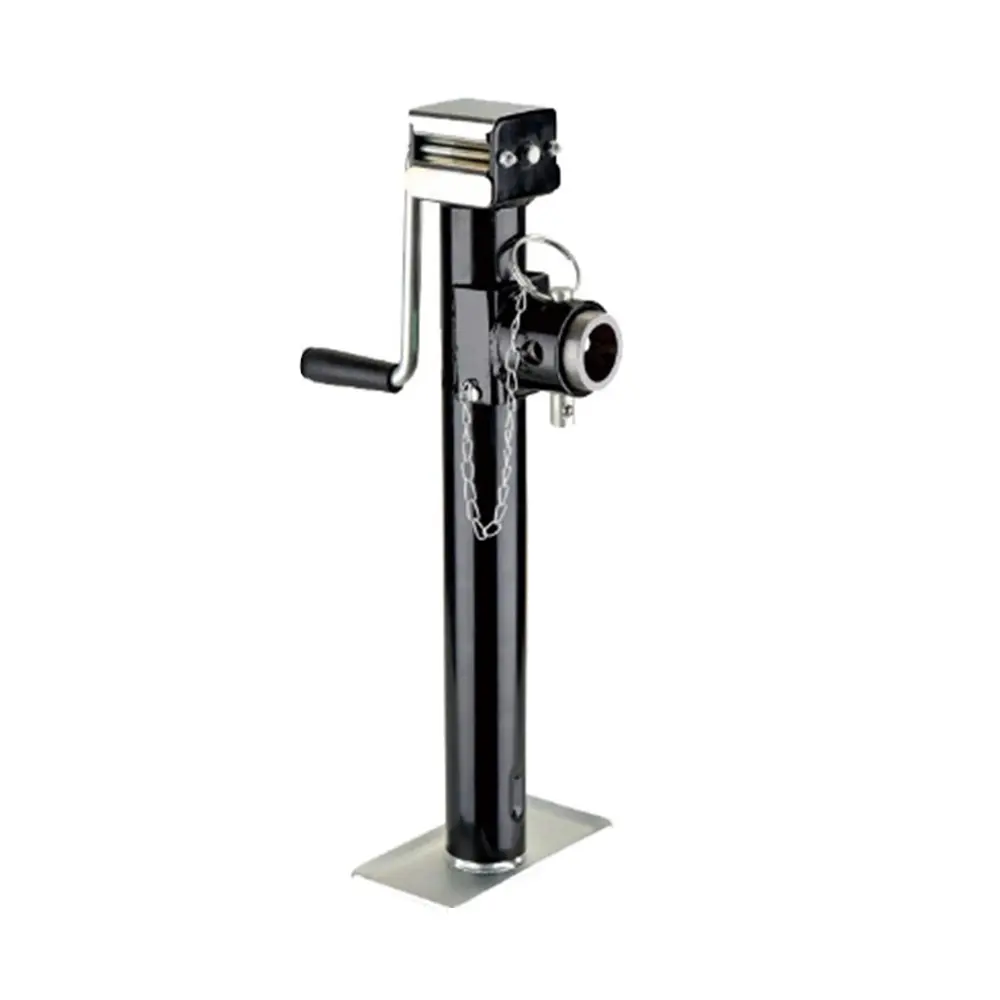
A drop leg trailer jack—sometimes called a drop-leg or side-wind drop jack—uses a two-stage design. The inner leg can be dropped quickly to the ground by pulling a pin or releasing a spring-loaded mechanism, and then the crank handle is used for the final lifting and fine adjustment.
How It Works
Pull the pin or release the spring to drop the inner leg close to the ground
Secure the pin or allow the spring to lock the leg
Crank the handle to lift the trailer to the desired height
This two-stage action means you spend far less time cranking. Instead of winding the jack through its full travel every time, you drop the leg to near the ground and crank only the final few inches.
Key Characteristics
Two-stage operation: quick drop plus fine crank adjustment
Reduced cranking effort: ideal for heavier trailers and frequent use
Available in side-wind and top-wind configurations
Common load capacities from light-duty up to heavy commercial ratings
Spring-loaded drop mechanisms on many models reduce manual handling
Best Applications
Heavy trailers where cranking through full travel is exhausting
Operators who hitch and unhitch frequently
Flatbed and equipment trailers with high tongue weights
Commercial fleets where time per hookup matters
What Is a Swivel Trailer Jack?
A swivel trailer jack is mounted on a pivoting bracket that allows the entire jack assembly to rotate up and out of the way when the trailer is hitched to the tow vehicle. When stowed, the jack sits horizontally alongside the tongue rather than hanging vertically toward the ground.
How It Works
With the trailer unhitched, the jack hangs vertically for use
After hitching, pull the release pin and rotate the jack up to the horizontal stowed position
Lock the pin to secure the jack for travel
Reverse the process when unhitching
The key benefit is ground clearance. A vertical jack hanging below the tongue can scrape on steep driveways, speed bumps, or rough terrain. A swivel jack eliminates that risk by tucking up out of the way.
Key Characteristics
Pivoting mounting bracket with a locking pin
Eliminates ground clearance problems during travel
Available in bolt-on and weld-on configurations
Can be combined with drop-leg mechanisms for a two-in-one solution
Common on utility, boat, and camper trailers
Best Applications
Trailers that encounter steep driveways, speed bumps, or uneven terrain
Boat trailers launching at ramps with changing ground angles
Campers and RVs where clearance matters
Any application where a fixed vertical jack risks dragging
What Is a Top Wind Trailer Jack?
A top wind trailer jack has its crank handle positioned vertically at the top of the jack. The handle turns in a horizontal circle, driving the internal screw mechanism to raise or lower the trailer tongue.
How It Works
The jack is mounted vertically on the trailer tongue
The operator stands beside the jack and turns the top-mounted crank
The screw mechanism raises or lowers the tongue
A locking pin or friction mechanism holds the height setting
Top wind jacks are the simplest and most traditional design. They are also the most common on lighter trailers because they are inexpensive and straightforward to maintain.
Key Characteristics
Vertical crank at the top of the jack
Simple screw mechanism with few moving parts
Lower cost than drop-leg or swivel designs
Compact footprint on the tongue
Common on light utility, boat, and small camper trailers
Best Applications
Small boat trailers
Budget-conscious buyers
Applications where the jack is used infrequently
Head-to-Head Comparison: 6 Critical Factors
① Ease and Speed of Operation
Drop Leg: The fastest of the three for lifting. Drop the leg, crank the final inches, done. For an operator hitching up several times a day, the time savings add up quickly.
Swivel: Fast for stowing, but the lifting action itself depends on the jack mechanism—a swivel jack with a simple screw drive still requires full cranking. A swivel combined with a drop leg gives the best of both.
Top Wind: The slowest for lifting because the operator must crank through the full travel every time. On a heavy trailer with a long travel distance, this becomes tiring.
Verdict: Drop leg wins on lifting speed; swivel wins on stowing speed.
② Ground Clearance During Travel
Drop Leg: A drop-leg jack typically hangs vertically unless it also has a swivel function. If it does not swivel, ground clearance can be an issue on uneven terrain.
Swivel: The clear winner. Rotating the jack horizontal eliminates the risk of scraping on driveways, ramps, and rough ground.
Top Wind: Hangs vertically and offers no stowing function. Ground clearance depends entirely on mounting height and trailer geometry.
Verdict: Swivel wins decisively on ground clearance.
③ Effort Required
Drop Leg: Lowest effort for the lift, because cranking is limited to the final adjustment.
Swivel: Effort depends on the lift mechanism. Swivel alone does not reduce cranking effort.
Top Wind: Highest effort, because the operator cranks through the full range every time.
Verdict: Drop leg wins on physical effort.
④ Cost
Drop Leg: Higher cost due to the more complex two-stage mechanism and spring-loaded components.
Swivel: Moderate cost. The pivoting bracket adds expense compared to a fixed jack, but less than a drop-leg mechanism.
Top Wind: Lowest cost. Simple construction and fewer components make it the budget option.
Verdict: Top wind wins on initial cost.
⑤ Maintenance and Durability
Drop Leg: More moving parts—springs, pins, drop mechanisms—mean more points that can wear or seize. Regular lubrication and inspection of the drop mechanism are essential.
Swivel: The pivot bracket and locking pin require periodic inspection, but the jack mechanism itself is typically simple. Fewer failure points than a drop leg.
Top Wind: Fewest moving parts and simplest maintenance. The screw mechanism needs occasional lubrication, and there is little else to go wrong.
Verdict: Top wind wins on simplicity and low maintenance; drop leg requires the most attention.
⑥ Versatility and Combinations
Drop Leg: Available in side-wind and top-wind versions, and often combined with swivel brackets.
Swivel: Can be combined with drop-leg mechanisms to create a jack that both drops quickly and stows horizontally—the most versatile configuration available.
Top Wind: Typically fixed and vertical. Limited versatility, but adequate for simple applications.
Verdict: A swivel drop-leg combination offers the greatest versatility.
Quick Comparison Table
| Factor | Drop Leg | Swivel | Top Wind |
|---|---|---|---|
| Lifting Speed | Fast | Depends on mechanism | Slow |
| Stowing Speed | Depends on swivel function | Fast | No stow function |
| Ground Clearance | Depends on swivel | Excellent | Limited |
| Physical Effort | Low | Depends on mechanism | High |
| Initial Cost | Higher | Moderate | Lowest |
| Maintenance | More moving parts | Moderate | Simplest |
| Best For | Heavy trailers, frequent use | Clearance-critical applications | Light-duty, budget use |
Which One Should You Choose?
Choose a Drop Leg Jack If:
You hitch and unhitch frequently and want to minimize cranking time
Your trailer has a heavy tongue weight
You operate a commercial fleet where time per hookup matters
You want to reduce physical effort for operators
You are willing to invest more upfront for long-term convenience
Choose a Swivel Jack If:
Ground clearance is a concern on your routes or driveway
You use a boat trailer with changing ramp angles
You have a camper or RV where a dragging jack is a real risk
You want the option to combine swivel with drop-leg for maximum versatility
You need to stow the jack quickly after hitching
Choose a Top Wind Jack If:
You have a light-duty utility trailer used occasionally
Budget is the primary consideration
The trailer is used on flat, well-maintained surfaces
You want the simplest possible maintenance
Ground clearance is not an issue for your application
Installation and Compatibility Notes
Mounting type matters as much as jack type. Bolt-on jacks are easier to replace and retrofit; weld-on jacks offer a more permanent, higher-strength connection. Check the tube diameter and mounting bracket compatibility before ordering a replacement.
Load rating must exceed tongue weight. As a rule, choose a jack rated at least 20% above your trailer’s loaded tongue weight. Underrated jacks wear out prematurely and can fail under load.
Check travel range. Measure the retracted and extended heights to ensure the jack can lift your trailer to a level position and still provide adequate ground clearance when stowed.
Final Thoughts
The choice between drop leg, swivel, and top wind trailer jacks is not about which is “best” in absolute terms—it’s about which fits your trailer, your workflow, and your operating conditions.
Drop leg jacks save time and effort on heavy trailers used frequently. Swivel jacks solve ground clearance problems and stow out of the way. Top wind jacks offer simplicity and low cost for light-duty applications. And a swivel drop-leg combination delivers the best of both worlds.
Whichever you choose, match the load rating to your tongue weight, check the travel range, and prioritize quality. A jack that fails is not just an inconvenience—it’s a safety event waiting to happen.
Explore our complete trailer jack lineup—drop leg, swivel, and top wind—at HangCheng Parts. We’ll help you match the jack to your trailer, not the catalog. 👉 https://www.hangchengparts.com/trailer-jack/
Contact us for more information; bulk orders enjoy discounts.
Related Products