Introduction
Choosing between side wind and top wind trailer jacks is a critical decision that impacts safety, operational efficiency, and total cost of ownership. With 30% of trailer accidents linked to improper jack selection or installation, understanding the differences in jack types and travel sizes is non-negotiable for fleet managers, trailer manufacturers, and logistics operators.
This guide breaks down the mechanical advantages, applications, and limitations of side wind and top wind jacks, alongside travel size calculations tailored to your trailer specifications. Backed by engineering data and industry compliance standards, you’ll learn to optimize jack selection for durability, safety, and performance.
1. Side Wind vs. Top Wind: Key Mechanical Differences
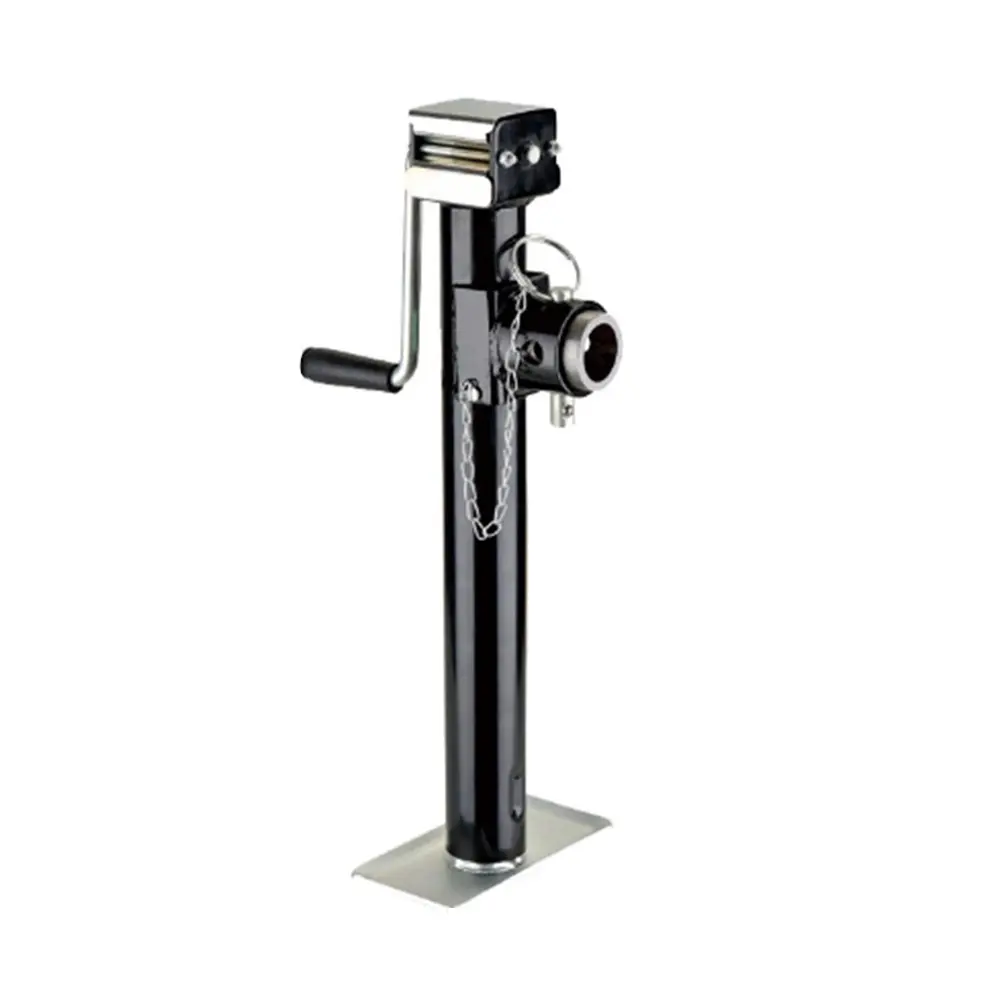
Side Wind Jack
-
Mechanism: Crank handle positioned horizontally on the jack’s side.
-
Best For: Tight spaces where vertical clearance is limited (e.g., under trailers with low-profile designs).
-
Pros:
-
Ergonomic operation: Reduced strain during cranking.
-
Compact design: Ideal for integrated trailer A-frames.
-
-
Cons:
-
Lower gear protection: Exposed to debris and corrosion.
-
Capacity limitations: Typically rated for ≤5,000 lbs.
-
Top Wind Jack
-
Mechanism: Crank handle positioned vertically atop the jack.
-
Best For: Heavy-duty applications requiring high torque and corrosion resistance.
-
Pros:
-
Sealed gearbox: Protects internals from moisture and debris.
-
Higher load capacity: Supports up to 15,000 lbs+ with reinforced gearing.
-
-
Cons:
-
Vertical clearance required: Unsuitable for low-profile trailers.
-
Maintenance complexity: Internal gears require specialized servicing.
-
Technical Comparison Table
| Feature | Side Wind Jack | Top Wind Jack |
|---|---|---|
| Max Capacity | 1,600–5,000 lbs | 5,000–15,000 lbs |
| Gear Protection | Unsealed (exposed) | Sealed gearbox |
| Handle Position | Horizontal side mount | Vertical top mount |
| Ideal Use | Marine trailers, utilities | Flatbeds, heavy equipment |
2. Travel Size Calculations: Why Lift Range Matters
Travel size (vertical lift range) determines how high a jack can raise a trailer coupler. Insufficient travel risks incomplete hitching or instability on uneven ground.
Travel Size Formula
Minimum Travel Required = (Trailer Coupler Height - Truck Hitch Height) + Safety Margin (4")
-
Example: If coupler height is 24″ and hitch height is 18″, required travel is:
(24" - 18") + 4" = 10" travel minimum.
Common Travel Sizes & Applications
-
6″–10″ Travel: Light-duty trailers (e.g., utility trailers, horse floats).
-
12″–18″ Travel: Heavy-duty trailers (e.g., construction equipment, lowboys).
-
20″+ Travel: Specialized applications (e.g., off-road trailers with oversized tires).
Pro Tip: For uneven terrain, add 50% extra travel to accommodate ground variances.
3. Material & Coating: Corrosion Resistance for Longevity
-
Zinc-Plated Steel: Budget-friendly for inland use; lasts 3–5 years.
-
Hot-Dip Galvanized: Withstands road salt and marine environments; lasts 8–12 years.
-
Stainless Steel: Maximum corrosion resistance; ideal for marine trailers.
Maintenance Insight: Side wind jacks require quarterly lubrication due to exposed gears, while top wind jacks need annual gearbox inspections.
4. Load Capacity & Safety Standards
-
Static vs. Dynamic Load: Jacks are rated for static loads (stationary trailers). Reduce capacity by 50% for dynamic operations (hitching/loading).
-
DOT Compliance: Ensure jacks meet FMVSS 393.130 for load stability and ASTM B117 for corrosion resistance.
Critical Rule: Always select a jack with 20% higher capacity than your trailer’s tongue weight.
5. Installation: Mounting Styles & Compatibility
-
Bolt-On Mounts: Ideal for replaceability and flexibility.
-
Weld-On Mounts: Permanent solution for high-vibration environments.
-
Swivel Bases: Allow 360° rotation for uneven ground adaptation.
Red Flag: Avoid mixing mount types—e.g., never weld a bolt-on jack.
6. Industry-Specific Recommendations
| Industry | Recommended Jack | Why It Works |
|---|---|---|
| Marine Trailers | Side wind (stainless steel) | Compact design; resists saltwater |
| Construction | Top wind (galvanized) | High capacity; handles debris |
| Agriculture | Top wind (zinc-plated) | Cost-effective for seasonal use |
| RV/Recreation | Side wind (powder-coated) | Ergonomics for frequent adjustment |
7. Cost Analysis: Side Wind vs. Top Wind
| Factor | Side Wind Jack | Top Wind Jack |
|---|---|---|
| Initial Cost | $80–$200 | $150–$400 |
| Lifespan | 3–7 years | 8–15 years |
| Maintenance Cost | $20/year (lubrication) | $50/year (gearbox service) |
ROI Tip: Top wind jacks offer 40% lower TCO over 10 years for heavy-duty users.
8. FAQs: Answering Top Buyer Questions
Q: Can I convert a side wind jack to top wind?
A: No. Gearbox orientation is factory-set; modification voids certifications.
Q: How do I measure travel size accurately?
A: Measure from fully retracted to fully extended positions under load.
Q: Are drop leg jacks compatible with both types?
A: Yes, but ensure leg diameter matches jack tube size (typically 2–3″).
Conclusion: Match the Jack to Your Operation
-
Choose Side Wind if: You need compact design, moderate capacity, and cost efficiency for light-duty trailers.
-
Choose Top Wind if: You require heavy-duty lifting, corrosion resistance, and long-term reliability.
Always prioritize:
-
Travel size over price—insufficient lift risks accidents.
-
Coating compatibility with your operating environment.
Need to order trailer jacks? Contact us for more information and get discounts on bulk orders.
Related Products