Introduction: Your Jack Is More Than a Stand—It’s a Critical Safety Tool
Every trailer owner faces that moment: you’ve hitched up, arrived at your destination, and need to disconnect. In that instant, a trailer jack transforms from a forgotten accessory into the single most critical piece of support equipment you own. Choosing the wrong jack isn’t just inconvenient—it’s a direct threat to your safety, your trailer, and your cargo. A jack that fails under load can cause catastrophic damage, injury, and costly repairs.
If you’ve ever wondered, “What kind of trailer jack do I need for my trailer?” you’re asking the right question. This comprehensive guide goes beyond basic types. We’ll break down the mechanics, compare every major style, and provide a clear, step-by-step selection framework based on your trailer’s Gross Vehicle Weight Rating (GVWR), your usage patterns, and your budget. By the end, you’ll be equipped to make an informed, safe purchase that will serve you reliably for years.
Part 1: Understanding Trailer Jack Fundamentals – Key Terms & Concepts
Before diving into types, master these essential terms:
-
Trailer Tongue Weight: The downward force exerted by the trailer’s tongue on the hitch ball. A proper jack must handle at least 150% of your maximum tongue weight for a safety margin.
-
Gross Vehicle Weight Rating (GVWR): The maximum total weight of your trailer (including cargo). This is the most important number for jack selection.
-
Lift Capacity/Rating: The maximum weight a jack is designed to safely lift. Never exceed this.
-
Travel/Lift Height: The distance the jack can extend from its collapsed to fully raised position. Must be enough to clear the ground when connected and lift the coupler high enough to engage/disengage the hitch.
-
Crank Style: Manual (hand-crank) or electric motorized.
Part 2: The Main Types of Trailer Jacks – A Detailed Breakdown
Trailer jacks are categorized by their mounting style and operation. Here is a detailed comparison of the most common types.
| Jack Type | Key Features & Mechanism | Best For | Key Considerations |
|---|---|---|---|
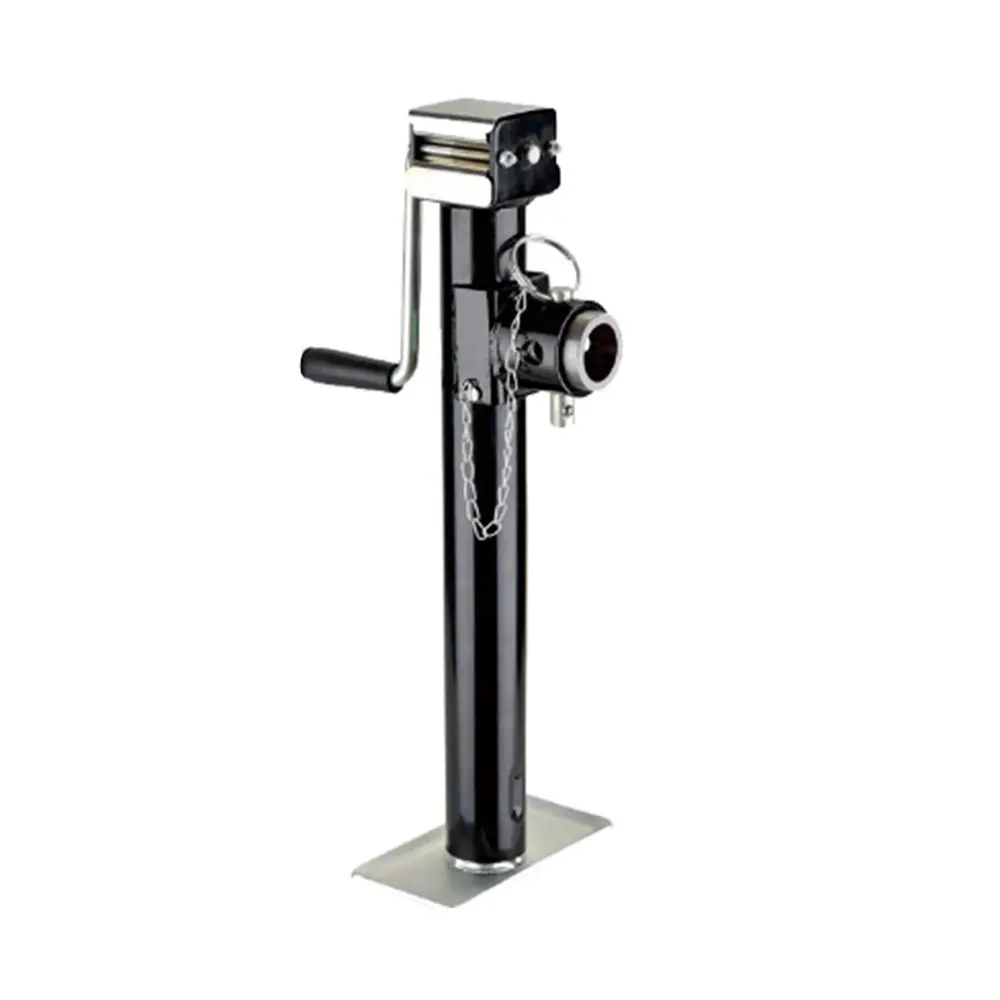
| A-Frame Jack (Fixed Mount) | • Mounted permanently to the trailer’s A-frame/coupler area. • Swing-Bolt or Pin allows it to pivot up for travel. • Lifts via a vertical, hand-cranked screw mechanism. |
• Most utility trailers (landscape, small boat). • Light to medium-duty applications. • Owners wanting a simple, integrated solution. |
• Limited lift capacity (often 1,000-2,000 lbs). • Can be awkward to crank at heavy loads. • Mounting location is fixed. |
| Drop-Leg Jack (Fixed Mount) | • A more robust version of the A-Frame jack. • Features a secondary pivoting “leg” that drops down, providing a wider, more stable base and increased lift height. |
• Medium-duty trailers (car haulers, larger equipment). • Tandem-axle trailers where more lift is needed. |
• Higher capacity than standard A-frame (up to 5,000 lbs common). • More moving parts (pivot pins) to maintain. |
| Front-Mount Swivel Jack | • Bolts onto the trailer’s front frame crossmember. • The entire jack assembly swivels 90-180° to be stowed horizontally for travel. |
• Trailers without a standard A-frame (e.g., some car haulers, flatbeds). • Heavy-duty applications where a drop-leg is preferred. |
• Offers great versatility in mounting. • Heavy-duty models (4,000-8,000+ lbs) are available. • Must ensure the frame is strong enough at mounting point. |
| Detachable/Receiver Jack | • Uses a hitch receiver tube mounted on the trailer. • The jack unit is separate, inserted and pinned like a hitch. • Can be used on multiple trailers or stored securely. |
• High-security needs (jack can be removed). • Multiple trailers with the same receiver size. • Avoiding corrosion in marine environments. |
• Most versatile system. • Must purchase jack and receiver separately. • Risk of the jack “walking” or twisting in the receiver under extreme side load. |
Sub-Type: The Power Decision – Manual vs. Electric
-
Manual Crank Jack: Reliable, no batteries required, lower cost. The go-to for most applications. Disadvantage: Can be slow and labor-intensive on heavy trailers.
-
Electric-Powered Jack: Operated by a 12V motor via a wired remote or switch. Offers effortless lifting, especially for high-capacity jacks or users with physical limitations. Disadvantage: Higher cost, requires battery power, more complex (potential motor/wiring failure).
Part 3: The 5-Step Selection Guide – “What Kind of Trailer Jack Do I Need?”
Follow this process to find your perfect match.
Step 1: Determine Your Trailer’s Key Numbers.
Find the GVWR on the trailer’s VIN plate or in the manual. If you don’t know your exact tongue weight, use the standard estimate: Tongue Weight = 10-15% of GVWR. Example: A 7,000-lb GVWR trailer has an estimated max tongue weight of 1,050 lbs. You’d want a jack rated for at least 1,500 lbs.
Step 2: Match Jack Capacity to Your Weight.
The Golden Rule: Your jack’s lift capacity must exceed your maximum expected tongue weight.
-
Light-Duty (< 2,000 lbs GVWR): A 1,200-2,000 lb capacity A-frame or drop-leg jack is sufficient.
-
Medium-Duty (2,000 – 7,000 lbs GVWR): A 3,500-5,000 lb capacity drop-leg or swivel jack is recommended.
-
Heavy-Duty (7,000+ lbs GVWR): A 6,000 lb+ capacity heavy-duty swivel or receiver jack is mandatory. Consider electric power.
Step 3: Evaluate Your Primary Use Case & Environment.
-
Frequency: Use daily? A smooth-operating, high-quality jack is worth the investment.
-
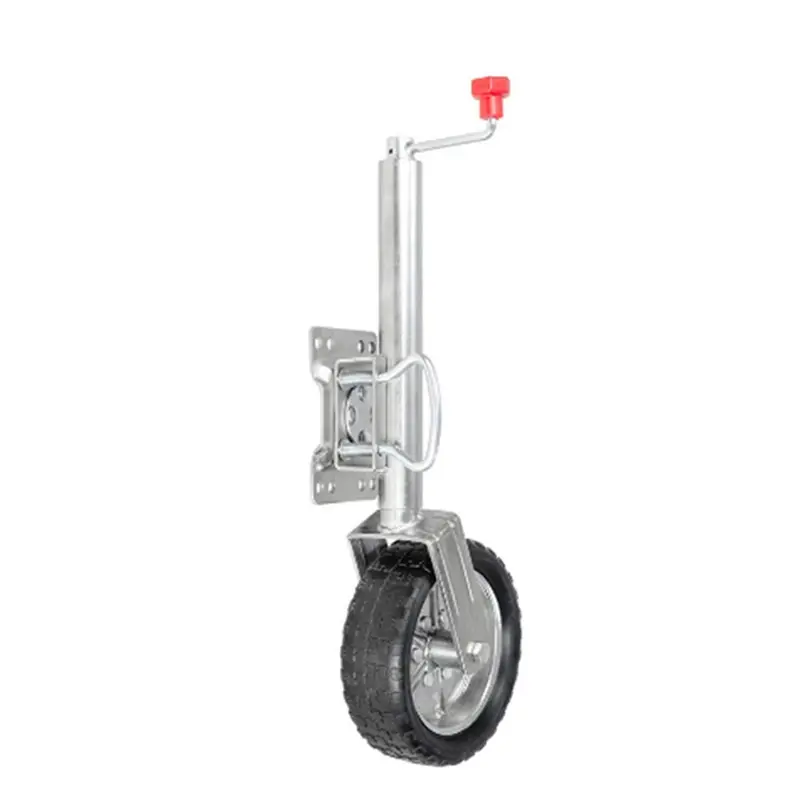
Surfaces: Often on soft ground (grass, dirt)? A jack with a wide footpad or optional wheel attachment is crucial to prevent sinking.
-
Security/Theft Concern: In a high-risk area? A detachable receiver jack is the safest choice.
-
Physical Ease: Have difficulty cranking? An electric jack conversion kit for your manual jack might be ideal.
Step 4: Consider Mounting, Travel, & Lift Height.
-
Mounting: Does your trailer have a standard A-frame (for fixed jacks) or would a front-mount/swivel be better?
-
Collapsed Height: Must be short enough to not interfere with hitching.
-
Lift Height: Must be enough to raise the coupler clear of your hitch ball at its highest point.
Step 5: Set a Budget & Prioritize Quality.
A jack is a long-term investment. Skimping can be dangerous. Look for:
-
Heavy-Gauge Steel Construction.
-
Quality Gearing (for manual) or a powerful, sealed motor (for electric).
-
Smooth-Lifting Screw with a protective boot to keep out grime.
-
Reinforced welds and corrosion-resistant finish (galvanized, powder-coated).
Part 4: Installation, Safety, & Maintenance Tips
-
Proper Installation: Ensure mounting bolts are grade 8 or higher and torqued to spec. For receiver jacks, use a tight-fitting pin and clip.
-
Always Use on Level, Stable Ground: Use a jack board or pavers on soft surfaces.
-
Never Rely Solely on the Jack for Long-Term Support: Once unhitched, place the trailer on jack stands under the frame for any extended storage or work.
-
Regular Maintenance: Periodically lubricate the screw mechanism and pivot points with grease. Inspect for cracks, rust, or bending. Keep the gearbox (electric) clean and connections tight.
Conclusion: The Right Jack is an Investment in Safety & Convenience
Answering “What kind of trailer jack do I need?” requires matching a tool’s capability to your trailer’s demands. By prioritizing capacity over all else, then factoring in your specific usage, environment, and need for convenience, you can select a jack that performs safely and reliably every time you disconnect.
Contact us to choose a sturdy and durable jack; bulk orders enjoy discounts.
Related Products